
Protect critical systems and keep operations resilient when conditions change.
Zoiko Tech brings secure engineering, identity, least privilege, threat prevention, security operations and resilience into a governed security architecture designed around accountable control, evidence and business continuity.
Evidence-aware controls. Explicit ownership. Least privilege. Resilience designed into operations.
What do you want to improve first?
Pick the closest goal and jump to the matching section.
Reduce exposure
Find and prioritize known, unknown, unsupported or misconfigured security conditions.

Strengthen identity & access
Apply least privilege, authentication and delegated authority with clearer boundaries.

Improve security operations
Create clearer triage, investigation, ownership and response states.

Secure engineering and change
Build prevention and control into configuration, environments and release workflows.

Improve resilience
Understand dependencies, degraded operation, recovery priorities and business continuity.

Review trust evidence
Evaluate current security, privacy, disclosure and assurance evidence.
Why security fails in silos
Assets are unknown
Show discovery, ownership and criticality, with an honest Unknown state instead of a pretend-complete inventory.
Access outlives purpose
Connect identity, entitlement, review and revocation to least privilege.
Controls have no owner
Every control and exception shows an accountable owner and review date.
Alerts lack business context
Tie each signal to the affected asset, identity, service and business dependency.
Incidents end at containment
Recovery, validation, lessons and evidence are part of the incident lifecycle.
Continuity plans are disconnected
Map critical services to dependencies and recovery priorities.
Trust claims drift from evidence
Use governed registries and explicit evidence states.
Security operating architecture
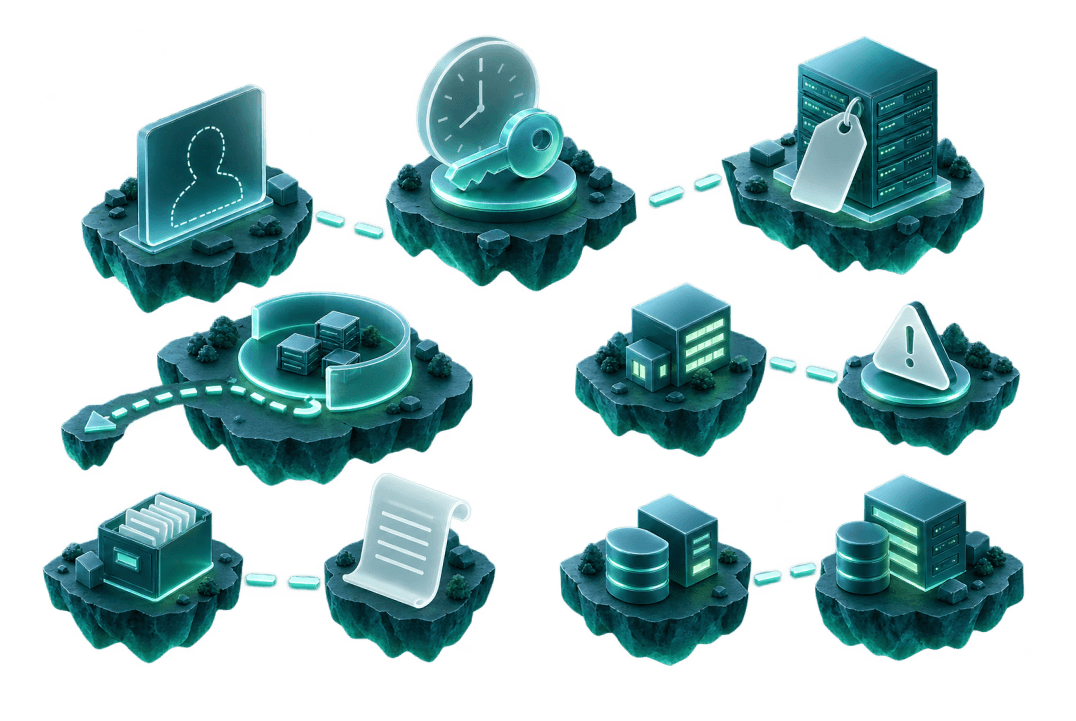
Security as a system of governed controls, not a list of tools. Seven layers, each answering one buyer question.
Evidence & governance
Control owner, evidence, exception, review date, policy / standard mapping and audit history.
Resilience & continuity
Dependencies, degraded operation, recovery priorities, alternate paths, business continuity.
Investigation & response
Triage, evidence, containment, remediation, recovery and closure.
Signals & observability
Security events, configuration state, identity events, service health, operational signals where supported.
Preventive controls
Secure engineering, configuration, least privilege, hardening, data and secret protection, change controls as approved.
Identities & authority
Users, admins, services, agents, integrations, roles, entitlements, delegated authority.
Critical services & assets
Applications, platforms, infrastructure, integrations, data stores and external dependencies, at a conceptual level.
Exposure and control posture
Visibility, ownership and remediation shown as factual states. Six statuses, no single security score.
State not established or evidence unavailable.
Owner review or evidence refresh required.
Known deviation, accepted through an approved process.
Corrective work in progress.
Current approved evidence exists.
Closed or removed, evidence retained.
Asset / service
Name and type, owner, business criticality, environment, lifecycle state.
Exposure / issue
Category, source, affected scope, first-known date where supported, current owner.
Control
Purpose, current status, evidence source, last review, next review.
Exception
Reason, approving authority, scope, expiry or review date, compensating control where approved.
Remediation
Owner, target date, status, validation and closure evidence.
Identity, access and least privilege
Identity is where much of the risk sits. The deeper authentication and entitlement architecture lives on the Identity & Access page.
Authentication
Only methods platform documentation supports.
Authorization
Roles, entitlements, scopes, permission boundaries.
Privileged access
High-impact authority kept separate from routine access.
Service identity
Non-human identities and integrations as governed actors.
Delegated authority
Who can act on behalf of whom, and within what scope.
Review & revocation
Periodic recertification, and rapid removal when role, risk or incident conditions require it.
Detection, investigation and response
A vendor-neutral incident lifecycle. It does not claim a specific SOC, SIEM or XDR product.
Incident command view (specimen)
Header
Incident INC-0001 (specimen) · Status: Investigating · Owner: Security lead · Affected: Sample service A.
Affected scope
Assets, identities, integrations and business services.
Evidence panel
Events, configuration state, approvals, related changes and notes at approved scope.
Actions
Assign, escalate, contain or restrict where supported, request evidence, mark recovery, close.
Secure engineering and change
Prevention built into design, configuration, environments and release. Testing or secure-SDLC evidence is published through Trust Center, not generic marketing claims.
Secure design
Threat-aware architecture and security requirements in system design, at an approved high level.
Environment separation
Development, test and production kept apart where supported.
Secrets and credentials
Scoped storage and handling. Real secrets never appear in screenshots.
Dependency governance
Third-party and open-source risk handled at the level product evidence supports.
Configuration and hardening
Secure configuration and baseline concepts, with no invented benchmark coverage.
Change and release
Security review, approval, evidence, rollback or containment, and post-release validation.
Vulnerability remediation
Issue ownership, prioritization, remediation and validation as a design pattern.
Resilience and business continuity
Resilience is broader than backup. Show dependencies, minimum viable operation, recovery priorities and a controlled return to normal.
Critical service
A process that must continue or recover within an approved priority.
Dependencies
Applications, identity, data, integrations, infrastructure, third parties, roles.
Degraded mode
What continues safely, what stops, and the approved alternate path.
Recovery priority & owner
Order or tier, with a named accountable role. RTO / RPO only if formally approved.
Validation
Evidence that recovered operation works and residual issues are understood.

Responsible disclosure and security evidence
Buyers are routed to authoritative evidence, not unverifiable marketing claims.
Security overview
Authoritative description of security architecture and operating principles.
Responsible disclosure
A clear vulnerability-reporting route with safe researcher guidance.
Certifications / attestations
Standard, scope, legal entity, issuer and expiry, using registry wording.
Policies / controls
Aligned / Designed to language where appropriate. Never implies certification.
Incidents / status
Current incidents live on System Status, not static marketing copy.
Assessment evidence
Approved summary and scope only. No sensitive findings.
Trust-claim status
Certified / Attested
A current certificate or attestation exists for the stated scope and legal entity.
Compliant
Only where legally and contractually supportable for the exact product, service and market.
Aligned / Designed to
Built with the standard in mind, not represented as certified.
Roadmap / Target
Future intention only, visually distinct, not procurement-ready.
Platform evidence
Named platforms appear only within approved descriptor, maturity, operator and evidence records.
Zoiko Shield
Primary delivery evidence for this solution. Public descriptor, maturity, operator, capabilities and markets only as approved.
Shared security capabilities
Controls embedded across Zoiko platforms, described only where platform owners approve.
Identity & Access
Adjacent control layer. Cross-linked, not duplicated.
Trust Center
Authoritative route for security, privacy, compliance, evidence and disclosure.
System Status
Authoritative route for service health. No hard-coded incident or uptime claims.
Integration and operational context
Security signals mean more with context. Internal telemetry and confidential architecture stay off this public page.
User, admin, service and delegated identities
Approved APIs, events and webhooks
Observability signals
Asset and service criticality
Recent approved changes
System Status and support routes
From critical scope to continuous improvement
Technology in practice
Proof appears only when approved for public use.
Security architecture case study
Initial risk, control architecture, rollout, evidence, approved result and limitation.
Incident / recovery note
Context, containment and recovery, control improvement, where disclosure is legally approved.
Resilience case study
Critical service, dependency risk, continuity design, validation, approved outcome.
Control evidence note
Control objective, implementation, evidence, review or expiry, limitations.
Where teams go next
Routes are contextual and never appear during an active incident, security exception or sensitive evidence review.
Cybersecurity / Zoiko Shield
Identity & Access → Regulatory & Compliance → AI Governance & Assurance
Identity-heavy program
Identity & Access → Cybersecurity & Resilience → Platform administration
Cloud / developer foundation
Cloud & Developer Infrastructure → Cybersecurity & Resilience → Modernization & Integration
AI / agent deployment
AI Governance & Assurance → Identity & Access → Cybersecurity & Resilience

Buyer questions, answered directly
Protect critical operations with security controls you can explain and evidence.
Talk with Zoiko Tech about the systems and services you need to protect, the identity and access boundaries that matter, the security operations you want to improve, and the resilience requirements that shape your environment.