

Domain-Specific AI
Specialized intelligence with real operating context and approved sources.
ARTIFICIAL INTELLIGENCE & AGENTIC SYSTEMS
Zoiko Tech develops domain-specific intelligence and governed agentic systems that connect models, knowledge, permissions, workflow execution, evidence and human oversight across real operating domains.

Route by domain, execution or control needs.
Specialized intelligence with real operating context and approved sources.

Bounded actions with approvals and evidence.

Reviewable steps, dependencies and accountable handoffs.

Policy, evaluation and controlled changes.

Public-ready interfaces, system boundaries and observability.
Control is structural, not a footer claim.

Use real vocabulary, workflow scope and approved sources.

Explicit identity, permission, policy and owner.

Unknown, conflicting or insufficient sources remain visible.

Consequential decisions and approvals retain accountable authority.

Denials, failures and changed state require reviewed next actions.
An intention, generated message or successful tool call is not the authoritative business outcome.
Objective and expected outcome.
Sources, system state and provenance.
Approved models and domain logic abstraction.
Proposed actions and dependencies.
Permission and authorized human gate.
Least necessary tool/system action.
Definitive downstream state.
Trace, evaluation and recovery context.
Derived intelligence stays distinct from authoritative facts.
Approved domain, role, workspace and process scope.
Authoritative systems, documents, policy and evidence.
Summaries, classification and recommendations clearly labeled.
Missing, stale, conflicting or restricted sources trigger review.
Professional, managerial or regulated authority remains with its responsible owner.
A proposed plan is not action authority.
Actor, objective, proposed steps, tools and dependencies remain reviewable.
Validate required data, system state, identity and policy.
Block material action until required authorization exists.
Minimum approved scope with traceable request/reference.
Downstream authoritative result, mismatch checks and allowed audit metadata.
Naming approval must not be inferred.

Generic steps, dependencies, decisions and system boundaries.

Evaluate action/data rules before material execution.

Review, judgment and exception ownership.

Approved scope and authoritative response.

Use the descriptive name; Zoiko Gesta exposure requires verified naming approval.
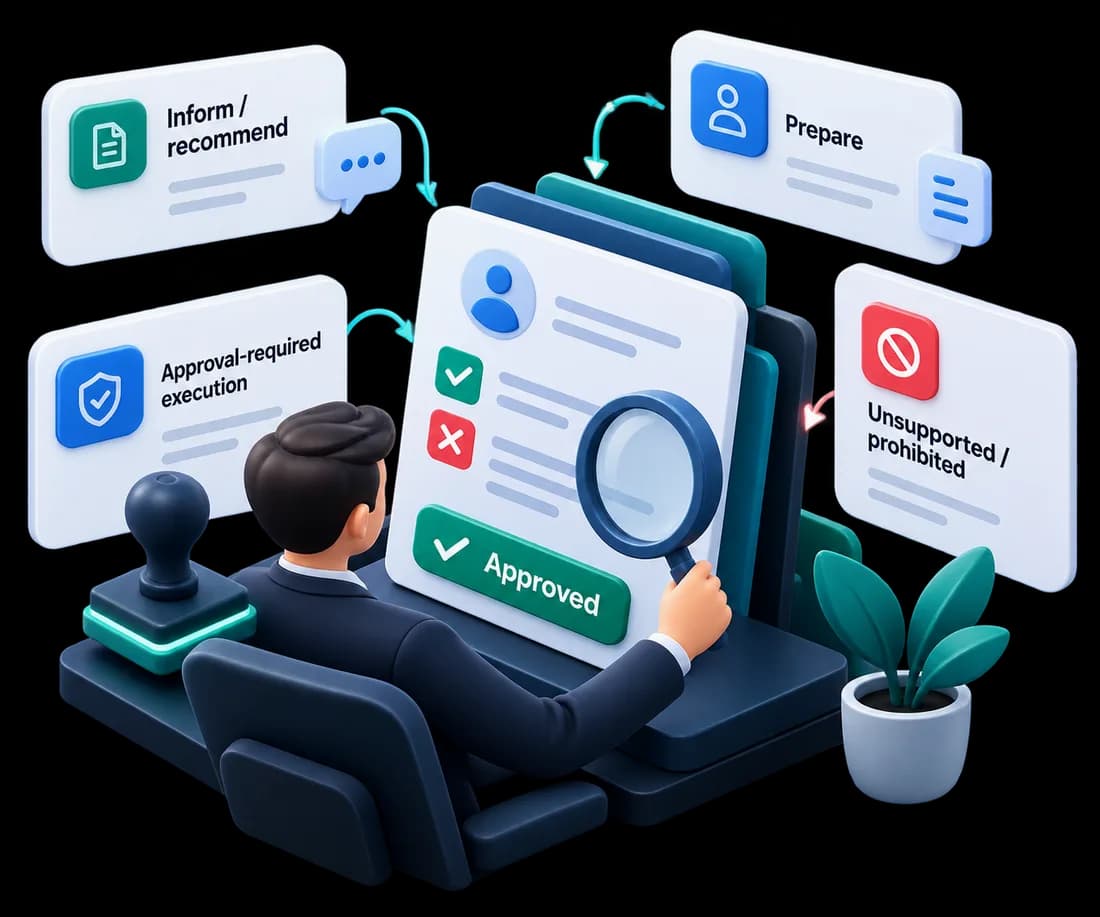
Informing, recommending and acting are different modes.
Human interprets; authorized person accepts, rejects or modifies.
Draft context or action for authorized review/release.
Prepare, block, seek authorization, then execute.
No execution when policy, authority, evidence or capability is insufficient.
Source lineage remains visible throughout the workflow.

Responsible system, policy or document for the task.

AI-extracted or inferred content is explicitly separate.

Version, effective time, stale and superseded state.

Trace to source set; do not merge disagreement into certainty.

Abstain, request information or route to review; retention follows approved policy.
Least privilege bounds both data and actions.
Person, service or agent with organizational context.
On whose behalf, which action, scope and duration.
Minimum tool/system/data permissions.
Approved use boundaries and access handling.
Source-backed controls only; no invented identity methods or assurance claims.
Evaluation is evidence, not universal safety certification.
Approved use cases, prohibited actions and approval gates.
Relevant tasks, conditions, limitations and reviewed evidence.
Named decision owner, approver and operator.
Re-review material model, source, policy or tool changes.
Scoped evidence; no invented scores, bias-free or compliant-AI claim.
Tool success is not automatically business completion.
Missing evidence or authorization keeps action blocked.
Preserve reason and safe next action.
Acknowledgment remains separate from authoritative result.
Accountable owner resolves inconsistent downstream state.
Only when supported; preserve reviewable evidence.
Architecture is not a product catalog.
Governed agentic intelligence infrastructure. Supplied navigation state: Finish / domain-stack landing page.
Governed agentic marketing operating system; exact public claims remain evidence-gated.
Only current approved platform/solution relationships.
Canonical names, ownership and readiness require registry validation.
No invented models, benchmarks, autonomy, latency, pricing, hosting or regulated eligibility.
Interfaces require public-ready technical contracts.

Approved APIs, SDKs and model interfaces only.

Current documentation and source-owned reference.

Sandbox/examples only when external access is live.

Supported observability, status and integration recovery.

No invented endpoint, event, credential flow, package or tool authority.
Begin with one bounded workflow.
Define intent, sources, owners and systems of record.
Scope data, policies, authority and evaluation.
Controlled bounded workflow with approved actions.
Validate failures, evidence and accountable recovery.
Only after capability, governance, integration and support readiness are approved.
No approved deployment records or measured results were supplied.
Authorized sources → derived analysis → human review.
Plan → policy/approval → bounded action → authoritative result.
Detect partial outcomes → escalate → retain evidence.
Actual deployment scope, product state and approved outcome.
No fabricated customers, metrics, accuracy or autonomous success claims.


Start with intent, sources, authority and the systems that own definitive results.
Product naming, public routes, capability, operator and support scope require approved current records.
Developer Resources preview →