
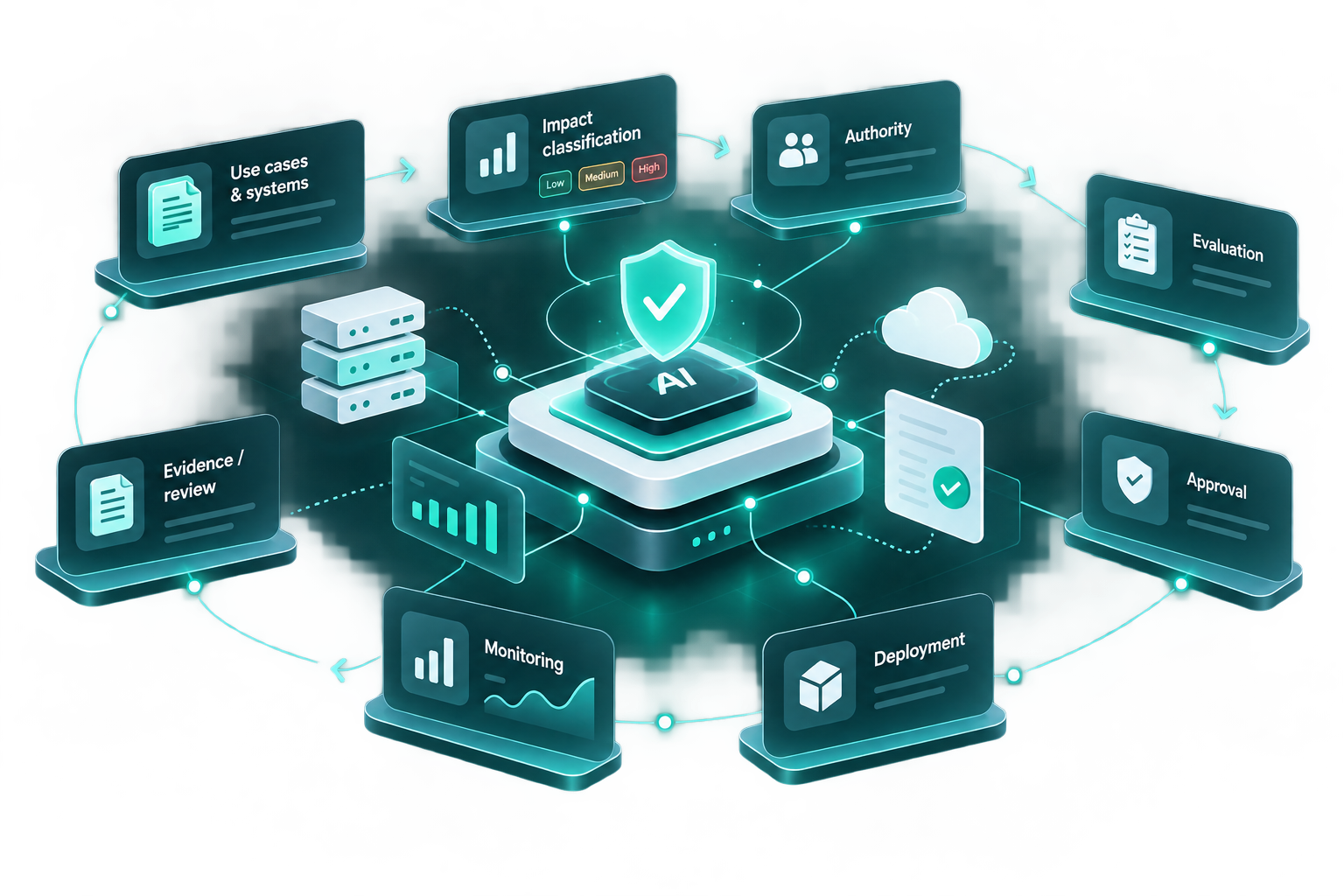
Govern AI systems and agents with evidence before, during and after deployment.
Zoiko Tech’s governance architecture connects AI use cases, system
ownership, agent authority, evaluation, evidence, human approvals,
monitoring and change control so organizations can deploy intelligence
with clearer accountability.
What do you need to govern?
Choose the closest intent and jump to the matching part of the governance model.

Inventory AI systems
Know which AI systems, models,
agents and use cases exist, who
owns them and where they run.

Approve AI use
Classify impact, define
conditions and record who
authorized deployment.

Govern agent behavior
Control data, tools, actions,
delegated authority and
escalation.

Evaluate before release
Test quality, policy, safety and
operational behavior against use-
case-specific criteria.

Prove governance
Preserve evidence, limitations,
approval and change history.

Operate AI safely
Monitor behavior, incidents,
exceptions, changes and re-
approval requirements.
Why AI governance breaks down
Incomplete inventory
Unknown, unregistered and
owner-missing states stay
visible.
Policy disconnected from
deployment
Every approved use is bound to
an actual system, version and
environment.
Tools exceed intended
authority
Explicit tools, actions, data scope
and approval conditions.
Evaluation doesn’t match
the use case
Scenario, outcome and policy-
specific evidence, not one
generic score.
Ceremonial oversight
Define who can approve, reject,
override, stop or escalate, and
when.
Evidence goes stale
Evidence is linked to version and
re-evaluated on material change.
Runtime failures escape
Monitoring, incidents,
containment and review are built
in.

AI governance operating architecture
The governance chain from intended use to accountable operation. Read from the bottom layer up.
L8 Evidence / history
Evaluation results, approvals, limitations, incidents,
changes, re-approval, retirement.
L7 Runtime / monitoring
Version, usage / state, exceptions, incidents, drift / change
indicators, ownership.
L6 Human decision
Reviewer / approver, conditions, exceptions, release
scope, evidence.
L5 Evaluation / controls
Scenario tests, quality, policy, safety / risk, tool behavior,
privacy / security, acceptance.
L4 Authority / impact
Assist, recommend, prepare, approval-required or
bounded execution; action classes and limits.
L3 Data / knowledge / tools
Approved sources, retrieval, tool / API access, credentials
/ identity, sensitivity boundaries.
L2 System / model / agent
inventory
Name, model / provider reference where approved,
version, environment, owner, operator, dependencies.
L1 AI use / business purpose
Use case, owner, intended users, domain, expected
outcome, prohibited use.
AI system and use-case registry
One inventory for systems, models, agents and use cases, with owners and status visible.
Registry field
Required content
System / use-case ID
Stable identifier.
Name / purpose
Concise outcome and business context.
Owner
Accountable business owner, plus technical owner where appropriate.
System type
Assistive AI, model service, agent / workflow, domain AI, embedded AI or other approved taxonomy.
Model / provider / version
Only where permitted and known. Unknown remains visible.
Environment / deployment
Development, test, pilot, production or retired.
Users / affected parties
Internal, customer, partner or public-facing context.
Data / sensitivity
High-level approved categories. Never sensitive production data.
Authority mode
Assist, recommend, prepare, approval-required or bounded execution.
Governance status
Draft, Review required, Pilot approved, Production approved, Restricted, Suspended, Retired.
Registry view (specimen data)
System
Purpose
Owner
Type
Version / env
Authority
Status
Next review
Sample assistant A
Summarize cases
Ops lead
Assistive AI
v1.2 · Production
Assist
Specimen date
Sample agent B
Prepare requests
Finance owner
Agent
v0.4 · Pilot
Prepare
Specimen date
Sample model C
Unknown
Embedded AI
Unknown
Unknown
Overdue
Impact and use classification
Transparent and multidimensional, never a black-box score.
.png)
Decision impact
Does the AI inform, recommend,
prepare or execute a material
decision or action?

Affected parties
Internal user, worker, customer,
partner, public or other group.
Domain sensitivity
Finance, HR / workforce,
healthcare, public sector,
security, legal / regulatory or
other.
Data sensitivity
Public, internal, confidential,
personal, regulated / sensitive or
unknown.
Action reversibility
Read / draft, reversible update, or
consequential and difficult-to-
reverse action.
Autonomy / authority
Assist through bounded
execution, with exact
permissions and approvals.
External dependency
Third-party model, data, tool /
API or partner dependency.
Regulatory / policy context
Applicable AI, privacy, sector,
security or internal policy review
state.
Agent authority and action controls
Actor identity
Named agent, workflow or
service identity with an
accountable human owner.
Tool allowlist
Approved systems, APIs,
functions and connectors the
agent may invoke.
Data scope
Permitted sources, fields,
sensitivity classes and
jurisdictions.
Action class
Read, draft, update,
communicate, transact, approve /
submit, delete / irreversible.
Limits
Value, volume, frequency, record
scope, environment, time or
geography.
Approval gate
Which action needs human
authorization, by whom and
under what condition.
Stop / containment
An authorized path to pause or
disable agent action.
Exception / escalation
When the agent must stop and
hand off to a human reviewer.

Authority modes
Mode
System behavior
Human authority
Assist
Generate, retrieve, summarize, classify.
Human decides and acts.
Recommend
Propose options or actions.
Human chooses or rejects.
Prepare
Assemble an action or transaction without executing.
Human reviews and confirms.
Execute with approval
Execute only after explicit approval.
Authorized approver releases the action.
Execute within bounds
Execute pre-authorized low-risk actions within explicit limits.
Human owns policy, monitoring, exceptions and revoke authority.
Evaluation and assurance
Use-case-specific and version-aware. No universal accuracy metric.
Task / outcome quality
Use-case-specific acceptance
criteria.
Policy adherence
Prohibited actions, approval
rules, data and tool boundaries.
Safety / harm scenarios
Misuse, unsafe output or action,
prompt / tool abuse, failure
scenarios at approved scope.
Tool / action behavior
Tool selection, parameters,
retries, partial completion,
downstream validation.
Human review
Agreement, correction, reject
and escalation patterns.
Privacy / security
Sensitive-data handling,
credential boundaries,
minimization, access controls.
Operational performance
Latency, cost, availability only
where evidence-approved.
Known limitations
Failure modes, unsupported use,
out-of-scope conditions, residual
risk.
Evaluation suite (specimen data): Sample agent B, v0.4, pilot environment
Scenario
Expected behavior
Result
Limitation / evidence
Request within limits
Prepare, don’t execute
Evidence attached
Blocked tool call
Stop and escalate
Retry behavior under review
Out-of-scope data
Refuse
Documented; fix required
Human oversight and approvals
Accountable owner
Named business or operational
owner for the use case.
Technical owner
Named owner for system, model
or agent implementation.
Reviewer
Security, legal / compliance,
privacy, domain or AI governance
reviewer by classification.
Approval
Pilot, production or restricted
state, with conditions and expiry
or review date.
Override
Authorized users can reject,
correct, pause or redirect AI
behavior.
Escalation
A defined path for uncertainty,
policy conflict, exceptions or
high-impact action.
Separation of duties
Configuration, approval,
operation and audit may be
separated for higher-impact
uses.
Approval decision record
Field
Required content
Decision
Approved; Approved with conditions; Pilot only; Restricted; Rejected; Suspended; Re-evaluation required.
Scope
System, version, environment, user group, workflow, authority mode.
Conditions
Required controls, monitoring, limitations, review frequency, action gates.
Evidence reviewed
Evaluation suite, security / privacy review, policy evidence, limitations.
Approvers
Authorized roles or names at the product-supported level.
Effective / review dates
When the decision starts and when it must be reviewed.
Rationale
Concise documented reasoning.
Evidence and decision record
System evidence
Version, configuration and
deployment metadata, owner,
environment.
Evaluation evidence
Scenario suite, result, version,
date, reviewer, limitations.
Policy / regulatory
evidence
Applicable policy and review
state. External legal claims stay
evidence-gated.
Security / privacy evidence
Review, access and data
boundaries, approved findings
and exceptions.
Approval evidence
Decision, conditions, scope,
approver, effective and review
date.
Runtime evidence
Incidents, exceptions, material
overrides, policy blocks,
monitoring state.
Change evidence
What changed, why, who
approved, what was re-
evaluated, release and rollback
state.
Runtime monitoring and incidents
Deployment state
Pilot, production, restricted,
suspended, retired.
Policy / guardrail event
Blocked, approval-required or
exception events at the
supported level.
Human override
Correction, reject, stop /
containment or escalation.
Operational failure
Unavailable model, service, tool
or integration; partial action;
stale context; timeout.
Quality / behavior signal
Use-case-specific monitoring.
No unsupported “drift” claims
without validated telemetry.
Incident
Security, privacy, safety,
compliance or operational issue
linked to a system and version.
Review trigger
Incident, threshold, model / tool /
data change, new policy,
scheduled review or owner
request.
Incident timeline (specimen)

Detection / report
Specimen incident
logged against Sample
agent B v0.4.
.png)
Triage
Owner assigned, scope
set at minimum
necessary level.
.png)
Containment
Agent paused by an
authorized role.
.png)
Correction / recovery
Previous approved
version restored where
supported.
.png)
Review / closure
Re-evaluation, policy
and process follow-ups
recorded.
Change control and re-approval
Material changes trigger explicit evaluation and approval, never silently inheriting old evidence.
Model / provider change
Review applicability of prior
evaluation; re-test affected
scenarios.
Model version change
Determine materiality and the
regression, safety and policy
evaluation required.
Prompt / system
instruction
Version and review if it materially
changes behavior or policy
enforcement.
Data / knowledge source
Review provenance, freshness,
sensitivity, jurisdiction and
outcome impact.
Tool / API / permission
Reassess action authority, failure
modes and security / privacy
boundaries.
Workflow / approval logic
Re-evaluate authority and
separation-of-duties
implications.
Policy / regulatory change
Route for qualified review;
update requirements only after
approval.
Change states
Proposed
Defined; not active
Review required
Impact and approvals identified
Evaluating
Required evaluation in progress
Approved for release
May move to defined scope
Released
Active with a new evidence chain
Rollback / contained
Previous state restored or use restricted
Re-approval overdue
Escalation or restriction rule applies
Responsible AI, security and privacy
Responsible AI
Governance, human oversight,
evaluation and accountable
deployment.
Security
Identity, least privilege, tool and
credential boundaries, secure
integration, incident response,
containment.
Privacy
Purpose limitation, data
minimization, sensitive-data
boundaries, retention.
Compliance
Applicable obligations and
evidence only where legally and
product-wise verified.
Reliability
System and tool health, failure
handling, versioning, rollback,
ownership.
Accessibility / human-
centered design
Review interfaces, notices and
human decision points are
accessible and understandable.
Platform evidence
Evidence is source-grounded. There is no dedicated AI-governance product name, and none is invented.
Zoiko AI
Governed agentic intelligence
infrastructure covering agentic
intelligence, AI architecture,
domain AI, responsible AI and
governance.
Responsible AI
The authoritative public trust
route for AI governance, safety
and accountability.
AI & Agentic Automation
Adjacent solution when intent
shifts from governance to
deployment.
Relevant domain AI
Approved system and use-
case evidence with owner,
maturity and governance
status.
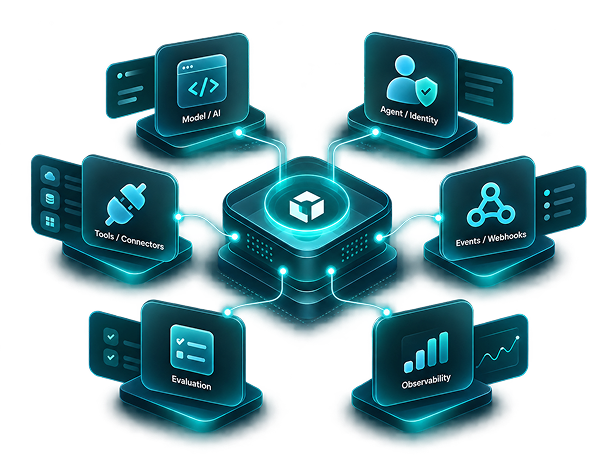
Integration and developer layer
Model / AI service
interfaces
Exact model APIs and providers
only where public and approved.
Agent / workflow identity
Named identity, owner, scopes
and delegated authority where
supported.
Tools / connectors
Approved tool registry,
permissions, environment and
health.
Events / webhooks
Governance, approval, incident
and change events where
supported.
Evaluation tooling
Scenario suites, test fixtures,
versioning and evidence at
approved scope.
Observability
Logs, events, policy decisions,
tool calls, approvals and state
where exposed.
Start with an inventory, then expand
Inventory AI
Register systems,
models, agents, owners,
use cases, data, tools,
deployment state.
Inventory baseline approved
Classify use / impact
Purpose, affected users,
domain, data, authority,
applicable policy.
Classification reviewed
Define controls
Authority, approvals,
boundaries, evaluation,
evidence, monitoring,
incident ownership.
Control design approved
Evaluate
Use-case-specific
scenario, policy,
security, privacy and
operational tests.
Criteria met or limitations
documented

Approve / pilot
Record human decision,
conditions, scope and
review trigger.
Decision recorded

Operate / monitor
Track exceptions, policy events, incidents, changes, review dates.
Ownership confirmed

Re-evaluate / expand
Review material changes; add use cases only when evidence and governance suffice.
Periodic review completed

Technology in practice
Proof appears only when approved for public use.
AI governance
Fragmented AI use, governance
architecture, evaluation and
approval, deployment, approved
outcome.
Agent governance
Agent purpose, tools and
authority, evaluation, approval,
runtime oversight, result.
Assurance report
System and version, scope,
scenarios and controls, results,
limitations, reviewer, decision.
Incident / change note
Issue or change, containment
and review, re-evaluation,
updated approval state.
Where teams go next
Routes are contextual. Nothing promotional appears while a reviewer handles an incident,
high-impact approval, restricted use or governance exception.
AI Governance & Assurance
AI & Agentic Automation, Identity
& Access, Cybersecurity &
Resilience.
AI / agent deployment
Governance first, then
Regulatory & Compliance where
applicable, then the domain or
industry solution.
Regulated AI
Regulatory & Compliance, AI
Governance & Assurance,
relevant domain AI.
Developer / model platform
Cloud & Developer Infrastructure,
AI Governance & Assurance, AI &
Agentic Automation.
Enterprise SaaS with
embedded AI
Technology & SaaS, AI
Governance & Assurance,
platform-specific admin controls.
Buyer questions, answered directly
Move AI governance from policy
documents into accountable operating
controls.
Talk with Zoiko Tech about the AI systems and agents you need to govern, the actions and
data they can access, the evaluation and evidence your reviewers require, and the right path
to establish accountable deployment controls.